


The WAGO Group is one of the world’s leading providers of connectivity and automation technology as well as interface electronics. In the field of spring clamp technology, this family-owned company holds a global market-leading position. Since its founding in 1951, WAGO has grown steadily and today employs approximately 9,000 people worldwide.
In project work involving complex customer demands, precise and consistent requirements and specifications are the key to success—and also one of the greatest challenges.
Requirements management often involves manual document reviews, labor-intensive data capture, and hand-crafted phrasing. Until now, there have been no efficient, AI-based tools to systematically extract requirements from PDF documents, cluster them, and guarantee the quality of their formulation.

“As we continuously strive for innovative solutions, AI offers us the ability to derive requirements precisely and efficiently, giving our employees more room for creative work.”
Patrick Grembowietz, Technology Manager
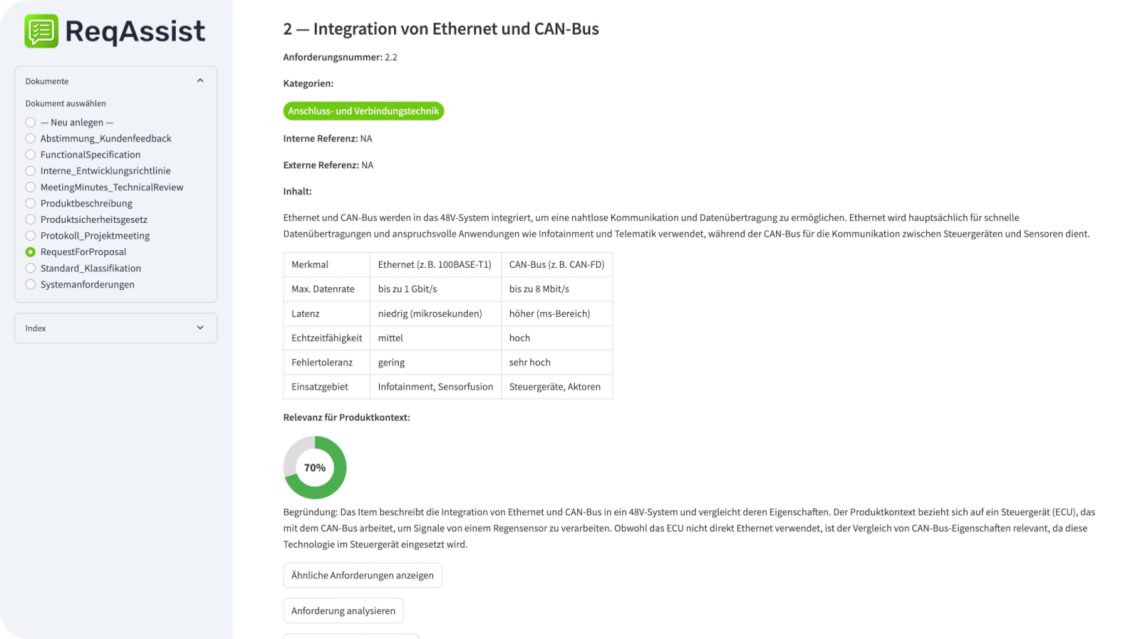
In a jointly conducted Proof of Concept (PoC), WAGO and AI Marketplace explored how state-of-the-art AI technologies can enable a smarter, future-oriented requirements management process. The aim was to prototype the full workflow—from importing PDF documents, through intelligent mapping to existing structures, to AI-assisted wording support.
Core PoC Features:
Automated PDF Import: Requirements are extracted directly from PDFs and converted into a structured, machine-readable format.
AI-Powered Clustering: AI automatically assigns individual requirements to existing chapters, system modules, or specification structures—offering suggestions for topics not yet covered.
Intelligent Formulation Assistance: AI assistants guide subject-matter experts in optimizing, standardizing, and clarifying requirement statements.
Continuous Feedback Loop: Users can validate and refine AI suggestions – the aim is for the solution to learn continuously in the future.
Implementation followed a deliberately agile, user-centric approach:
Despite being a prototype, the PoC clearly demonstrated the technology’s potential:
Time Savings: Initial import and structuring of requirements from PDFs were reduced to just a few minutes.
Enhanced Clarity & Organization: AI-driven clustering helped identify redundant or related requirements at a glance.
Improved Quality: AI-assisted phrasing suggestions enabled clearer, more consistent, and verifiable requirement statements.
The Proof of Concept confirmed that modern AI technologies are ready for practical use in streamlining requirements management. As a next step, WAGO will evaluate how to integrate this solution into its production environment—focusing on further automation and deeper support for subject-matter experts in creating and maintaining requirements and specifications.
Allow loading Youtube-videos on ki-marktplatz.com?
 Let us show you interesting and helpful content in the quickest way possible.